
Resources
Medical office or regular office: what changes in the cleaning plan
A medical suite and an accounting firm can share a floor plan and still need very different cleaning. Here is what changes room by room, what stays the same and what to put in writing before the first visit.
Similar floor plans, different jobs
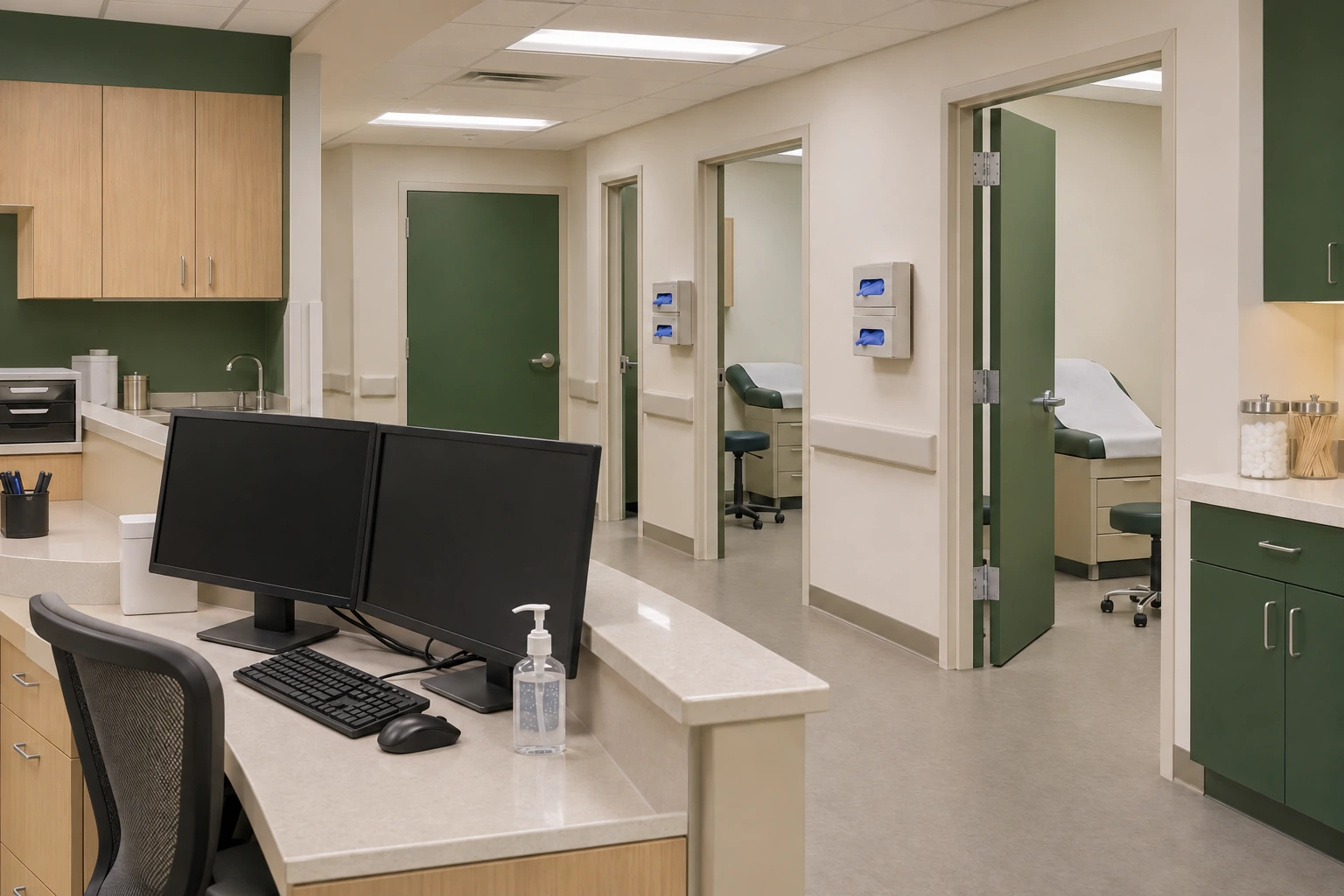
From the corridor, plenty of medical suites look like any other tenant: a reception desk, a few private offices, a breakroom and a pair of restrooms. The difference sits behind the front counter, in rooms where staff examine and treat people, and in the steady flow of visitors who sit, sign in and use the restroom between appointments. An ordinary office is cleaned for a team that comes back every morning. A practice is cleaned for that team plus everyone who walks through its door.
That shifts the plan in five places: who sets the steps, which products are used and how long they stay on, how often patient-facing rooms get attention, which floors and furniture the crew works on, and when the visit happens. Dusting, trash, vacuuming and restroom work look much the same in both. It is everything around them that changes.
The practice sets the rules for clinical rooms
In a regular office, the office manager and the cleaning company agree on a task list, and the crew works through it. Exam and procedure rooms come with their own rulebook. The practice’s written protocol decides the products, the order surfaces are cleaned in and how a room is marked ready again. A good cleaning plan points to that document rather than rewriting it in its own words.
In practice, that means a short handover before the first visit: the protocol itself, a list of rooms with what each one is used for, and a staff member to call with questions. When the protocol is revised, send us the new version and the cleaning plan is updated to match. An accounting firm or a design studio has nothing comparable, and a one-page task list covers it.
Products, and the minutes they need on a surface
An office routine runs mainly on a neutral cleaner, glass cleaner and a disinfectant for restroom fixtures and kitchen handles. A medical routine adds disinfectant to a much longer list of surfaces: exam-room counters, the check-in desk, waiting-room chair arms, door hardware and the patient restroom. Medical cleaning plans call for EPA-registered disinfectants that match the practice’s protocol, and each one has a dwell time printed on its label.
Dwell time changes the pace of the work. A product that has to stay wet for several minutes can’t be sprayed and wiped in one motion, so the crew cleans a surface first, applies the disinfectant, moves on to the next surface and comes back to wipe. Following the label on every touch point is the main reason a medical suite needs more time per visit than a plain office with matching square footage.
Where the room-by-room differences show up
Walk through a typical suite and the contrast with office cleaning is easy to see:
- Waiting room: an office lobby gets dusted and vacuumed; a waiting room also has every chair arm, side table and the sign-in counter wiped and disinfected each cleaning night
- Patient restrooms: busier and more varied use than a staff restroom, so a full clean every night and, in a busy practice, checks during clinic hours
- Exam and procedure rooms: no office equivalent, cleaned to the protocol, with terminal cleaning booked when a room comes out of use
- Billing and admin offices: cleaned the way any office is
- Staff breakroom: the same counters, sink, appliances and floor as an office kitchen
The admin side is where a split plan saves time. A billing office or a back hallway of filing cabinets gains nothing from a clinical routine, and running one there only lengthens the visit. Dividing the suite into clinical, patient-facing and back-office areas lets each carry the task list it actually needs. For daytime upkeep in the patient-facing rooms, our guide to cleaning between patients covers porter rounds during clinic hours.
Floors and furniture built for wiping
Medical suites usually carry more hard flooring than offices do. Sheet vinyl, luxury vinyl plank and sealed tile are common in exam rooms and treatment corridors, while an office runs carpet through most of its desks. Hard floors are damp-mopped every cleaning night and need periodic scrubbing and refinishing as rolling stools and carts wear down the finish; commercial floor care handles that work on a day the practice is closed.
Furniture matters as well. Fabric waiting-room chairs hold onto spills and are slow to dry, while vinyl or other wipeable upholstery goes through the nightly wipe-down in seconds. When a practice refurnishes, choosing wipeable seats, sealed counters and closed storage makes every evening visit faster. Carpet that does remain in a waiting area takes heavier foot traffic than most office carpet, so it tends to need extraction sooner.
Timing, paperwork and privacy
Office cleaning often goes on while a few people are still at their desks. A clinical room can only be cleaned to protocol once it is empty, so a practice’s visit begins after the last appointment has finished. Early-morning clinics, late evening hours and Saturday sessions all need a cleaning window set around them, and that window belongs in the plan from the start.
Medical offices also keep more sensitive material in plain view: printed schedules, charts on a counter, screens left logged in. The plan should state that crews clean around papers and screens without reading or moving them, and should name any room, such as a records room, that stays locked or off the list. Our medical office cleaning crews work with that kind of discretion and are background-checked before they start.
What to put in writing for a medical suite
A medical cleaning plan does not need to be long, but it does need more pieces than an office plan. The basics to bring to the first visit, starting with your written protocol, are listed on the medical office cleaning page. Beyond those, settle:
- A floor plan or room list marked clinical, patient-facing or back office
- Nightly tasks for each area, plus any checks during clinic hours
- Clinic hours, closed days and a window for periodic floor work
Review the plan whenever a room changes use, such as an office converted into a procedure room, or when the practice adds hours. To start one for your practice, get a quote and send your protocol along with the room list. Aeroso Janitorial will set up each area on the schedule it needs.
Common questions
Does a medical office cost more to clean than a regular office?
Yes, as a rule. Disinfecting more surfaces, waiting out each product’s dwell time and following a protocol in every clinical room add time per square foot compared with an office routine.
Can one crew clean our admin offices and our exam rooms?
Yes. A single visit covers both, with the admin rooms on an office task list and the clinical rooms on your protocol.
Who chooses the disinfectant used in exam rooms?
The practice. Its protocol names the products, and the crew uses those, each one left on for the dwell time on its label.
What is terminal cleaning?
A thorough clean of a room when it comes out of use, done to the facility’s protocol before the room returns to service. It is booked on top of the nightly visit.
Will Aeroso Janitorial follow our written cleaning protocol?
Yes. Exam and procedure rooms are cleaned to your practice’s protocol, including terminal cleaning whenever you book it.